The modern market is in the midst of the largest transformation in the history of the retail and hospitality sectors. While just a few years ago we spoke of separate channels and distinguished online shopping from visiting physical locations, today that boundary has completely blurred. At their core, customers have become channel-agnostic. They couldn’t care less whether your e-commerce team communicates with the team managing your brick-and-mortar stores. The customer sees only one brand, one logo, and one promise.
When a person closes their laptop, puts their phone in their pocket, and walks through your doors, they expect their shopping experience to continue without a single second of interruption or loss of context. In practice, however, it is precisely at this transition that a deep systemic disconnect too often occurs—one that destroys loyalty and bleeds revenue.
The anatomy of the systemic disconnect at the checkout counter
Let’s look at a classic scenario playing out daily in most companies. A customer spends hours on your website, browsing your selection, adding items to their cart, and actively researching specific services. Your web analytics know a massive amount about them. But when that same customer physically visits your location the next day, the digital trail goes completely cold. At the register, they become a total stranger. No one knows their history, their preferences, or the effort they just put into researching your offerings. In the end, they receive a dry paper receipt and a generic question that has absolutely nothing to do with their actual needs.
This phenomenon is known as a digital blackout. It is a critical friction point where businesses voluntarily discard invaluable context. Physical locations have an extraordinary advantage because they offer genuine human interaction, touch, immediate experience, and an emotional component to purchasing that the web can never replicate. However, without technological support, these locations are flying blind. They cannot recognize a customer’s value in real time, they don’t know how to tailor offers, and they cannot predict the next logical step in the buying cycle.
The phygital concept as a strategic response to modern challenges
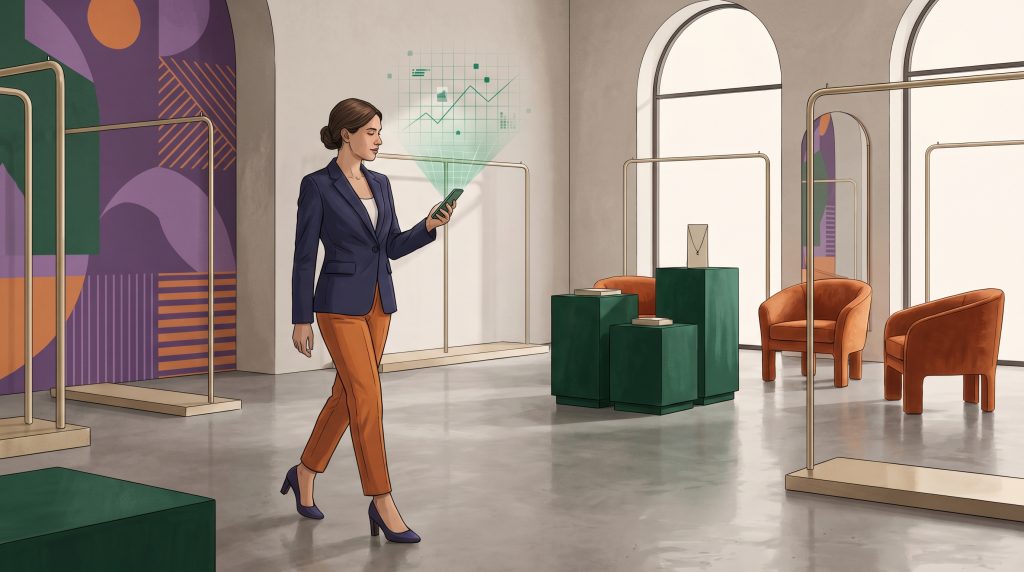
The solution to this challenge comes in the form of a phygital strategy, which represents a meaningful and seamless blending of the physical and digital environments. The purpose of this concept is not to introduce technology for technology’s sake. The goal is to use digital tools to strip away all administrative and operational friction from the physical space, empowering your sales staff to become highly informed consultants.
When you integrate smart loyalty systems and modern identification into a physical space, the entire experience comes alive at a higher level. Imagine a customer receiving a digital voucher or gift card via the web or a mobile app. The moment they step into your store, the POS system instantly recognizes their identity, loyalty tier, and purchase history. The transition is fast, elegant, and entirely personalized. In this way, a company doesn’t just speed up on-site operations—it proves to the customer that they are known, valued, and respected.
Data sovereignty and the advantages of closed-loop systems
The foundation of a successful phygital transformation is not the devices on the floor, but the secure and centralized flow of information. If your data is fragmented across various vendors, online platforms, and isolated cash registers, a cohesive experience is simply impossible to build. You need your own centralized ecosystem that acts as a single source of truth.
This is where the definitive advantage of closed-loop gift card systems and advanced digital vouchers becomes clear. Unlike open-loop bank cards, where you hand over transaction data to financial intermediaries every single time, a closed-loop system keeps the entire circle inside your own house. When a customer loads funds onto your card, that money is securely tied to your brand and cannot bleed out to the competition. More importantly, every interaction—whether online or at a physical register—generates clean, accurate data directly linked to the customer’s profile. This data then becomes the fuel for future automated, hyper-personalized campaigns.
How to build the friction-free ecosystem of the future
The retail store or tourist destination of the future is not a space flooded with flashy screens that distract the visitor. It is a space where technology works quietly and almost invisibly in the background, reliably doing the heavy lifting of connecting information. Its job is to make the customer’s journey through your sales process as simple, inspiring, and fluid as possible.
The companies that are the first to successfully bridge the gap between the digital world and the physical retail shelf will secure long-term market leadership. Ultimately, customers will always reward the brand that offers them the most convenience, recognizes their loyalty at every step, and allows them to do business without borders. It’s time to move past outdated frameworks, tear down the walls between channels, and take full control of your sales and data ecosystem.